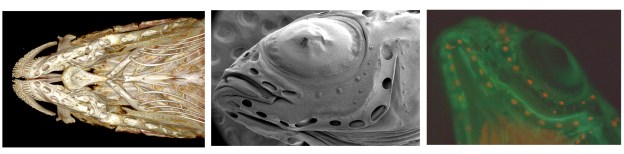
We work on the structural and functional evolution and developmental evolutionary biology of the lateral line system in a range of fishes including: coral reef fishes, North and South American freshwater fishes, African cichlid fishes, deep sea fishes, and elasmobranchs. We are also exploring the functional morphology of neuromasts, the organization of superficial neuromast arrays, and the effects of key environmental variables associated with climate change on the pattern and timing of lateral line development.
We use multiple methods including vital fluorescent imaging, histology, SEM, CT/µCT, and fate mapping to gain a comprehensive understanding of patterns of lateral line development and adult morphology. We were also the first to use CT and µCT imaging for the study of the comparative morphology of the swim bladder in live, anesthetized fishes and for visualization of the cranial lateral line canals. We have used DPIV (for analysis of hydrodynamic stimuli), video analysis, and classical fish training (conditioned responses to artificial hydrodynamic stimuli) to study the sensory basis for feeding behavior.
Funding for work in the Webb Lab has come from major grants from the National Science Foundation, NSF Graduate Research Fellowships, National Institute for Underwater Vehicle Technology (NIUVT), a Franklin Grant (American Philosophical Society), a Lerner Gray Grant (American Museum of Natural History, NYC), an Edward Raney Award (American Society of Ichthyologists and Herpetologists, ASIH), a Society for Integrative and Comparative Biology (SICB) FGST, a Laura and Arthur Colwin Summer Research Fellowship (MBL; Marine Biological Laboratory, Woods Hole), the George and Barbara Young Chair in Biology (at URI), RI NSF EPSCoR, and the University of Rhode Island.
PROJECTS (ongoing and completed)
Sensory Biology and the Impacts of Climate Change – two model species (Brook Trout, Atlantic Silverside) are being used to assess the effects of changes in key environmental variables (temperature, pH) on sensory development and its implications for key behaviors.
- Brook Trout is an iconic cold water species that is being subjected to increased water temperatures. In collaboration with Matt O’Donnell and Amy Regish at USGS (Conte Lab, Turner Falls, MA) we are asking questions about the effects of increased temperature on the pattern and timing of lateral line development, which is likely to have critical implications for behavior (flow sensing) during early life history. Work by PhD student Aubree Jones was funded by NSF Graduate Research Fellowship and NSF INTERN award. See Jones et al., 2025.
- The Atlantic Silverside is an abundant near shore marine species and the subject of climate change studies in the lab of our collaborator, Dr. Hannes Baumann (University of Connecticut) and his PhD student Max Zavell. We are asking novel questions about the effects of ocean acidification on the development and behavior of the lateral line system in this important species.
Structural and Functional Evolution in the Lateral Line System
- Structure-Function Relationships in Neuromasts – New collaborative, interdisciplinary projects with engineers are using computational and physical modeling to ask novel and exciting questions about how the morphology and configuration of individual neuromasts and “sensor arrays” contribute to flow sensing capabilities in fishes and to applications in engineering. Supported by grant from NIUVT/ONR (National Institute for Underwater Vehicle Technology).
Evolution and Development of the Lateral Line System – different taxa are being used to explore fundamental aspects of the developmental basis for phenotypic and functional evolution of the lateral line system.
- Evolution of Lateral Line Meristics – The structure and developmental basis for variation in the LL system on the trunk of fishes was explored through a comprehensive survey of LL and vertebral meristics and descriptive ontogeny of Atlantic silverside and Brook Trout, which have contrasting meristics.
- Three species of North American freshwater fishes are the basis for a study of the developmental basis for the evolution of LL phenotypes. The silverjaw minnow (Ericymba buccata = Notropis buccatus) has narrow canals on the dorsal surface of the head and widened canals on the ventral surface of the head (Reno 1971), an unusual example of regional specialization of the lateral line system, which is likely adaptive for feeding on invertebrates in sandy sediments (not unlike the cichlid Aulonocara; see below). Another North American minnow, Pimephales promalas (the fathead minnow), and a salmonid, brook trout (Salvelinus fontinalis) are providing a phylogenetically-informed comparisons. The developmental basis for regional specialization in the LL system and its behavioral consequences are being examined in Ericymba buccata. Work by PhD student Aubree Jones is funded by NSF Graduate Research Fellowship, Raney Award from ASIH, SICB Fellowship of Graduate Student Travel, and the URI Graduate School. See Jones et al., 2024a, b.
- The Skull of Bony Fishes: The Lateral Line System Holds the Key to a (Not so Novel) Interpretation of Cranioskeletal Modularity and Evolvability (2019-Pres.; In collaboration with Drs. Pedro Rizzato (U. Sao Paolo, Brazil) and Murilo Pastana , we are integrating historical literature and modern descriptive and experimental analyses. This will provide a new perspective on the identity and homology of lateral line canals and the bones with which they are associated and a consideration of modularity and evolvability in the skull of bony fishes.
- Convergent Evolution of Widened LL Canals in African Cichlids (2006-2017) – Representatives of two genera of Lake Malawi (Africa) cichlid fishes (Aulonocara [widened canals] and Tramitichromis [narrow canals]) were used for comparative anatomical, developmental, and behavioral studies that address fundamental issues in post-embryonic lateral line development, diversification of lateral line phenotypes (narrow, widened canals), and functional evolution of the lateral line system. We described the morphology and development of the lateral line system of Aulonocara and Tramitichromis (Becker, MS Thesis; Becker, et al., 2016; Carter, MS Thesis; Johnstone, MS Thesis), explored the role of heterochrony in phenotypic evolution (Webb, et al., 2014; Bird and Webb, 2014) established the role of the lateral line system in the detection of benthic prey in Aulonocara, and distinct differences in the sensory basis for prey detection in Aulonocara and Tramitichromis using live prey and artificial water flows (MAB Schwalbe PhD Dissertation; Schwalbe et al., 2012, 2016; Schwalbe & Webb, 2014, 2015). Most recently, this work was expanded to include the analysis of widened canals in Lake Malawi cichlids µCT imaging. Funded by a Franklin Grant from the American Philosophical Society, NSF grant IOS 0843307, RI NSF EPSCoR, and the University of Rhode Island.See: Cichlid Project page.
- Development of the Lateral Line System in Elasmobranch Fishes – We studied the development of the lateral line canal system in the little skate, Leucoraja erinacea. In contrast to the bony fishes, the cranial lateral line canals in elasmobranch fishes are not associated bone, but are contained in the soft tissue of the dermis surrounding the elements that compose the cartilaginous skull of these fishes. Furthermore, the pattern of development of the lateral line system in elasmobranchs contrasts with that in bony fishes in fundamental ways. The study of this contrast will shed light on how lateral line development evolved with the divergence of the cartilaginous (elasmobranch) and bony fishes hundreds of millions of years ago. Preliminary work was carried out at the Marine Biological Laboratory (MBL, Woods Hole) in collaboration with Dr. Andrew Gillis (Cambridge University, UK, now at MBL). Funded by a Laura and Arthur Colwin Endowed Summer Research Fellowship at the MBL and the University of Rhode Island. See Skate Project page.
Sensory Biology of Coral Reef Fishes – Coral reef fishes live in well-lit waters and are generally considered to be visually-oriented. However, the diversity of sensory systems possessed by fishes and our appreciation of sensory integration in fishes demands that we ask fundamental questions about the non-visual senses and their roles in diverse behaviors.
- Sensory Biology of a Sponge-Dwelling Goby – The life history of most coral reef fishes (and most marine fishes) includes a pelagic larval stage. Late stage larvae of coral reef fishes are known to have remarkable swimming abilities and can respond to olfactory, auditory, and/or visual cues to change their behavior and navigate to their settlement sites on reefs. However, the morphology and the pattern and timing of development of the sensory systems that underlie these behaviors are not well known. The ultimate goal of this project was to understand how the different sensory systems contribute to the orientation behavior of pelagic larvae, and to better appreciate the role of navigation behavior in determining settlement patterns and population connectivity in coral reef fishes. In collaboration with Dr. Peter Buston (Boston University), Dr. John Majoris (now at Penn State University) and Dr. Claire Paris (University of Miami), we used a goby (Elacatinus lori) for the first integrated analysis of the developmental anatomy of multiple sensory systems (olfaction, taste, lateral line, hearing, vision) and larval orientation behavior in a coral reef fish. Funded by NSF grant #1459224 (Ocean Sciences) to JFW, #1459546 to PM Buston, and #145156 to C Paris, and the George and Barbara Young Chair in Biology (URI). See: Sensory Basis for Larval Fish Orientation Behavior page
- The Laterophysic Connection of Butterflyfishes and Implications for Communication and Social Behavior – Many groups of teleost fishes have convergently evolved associations of the swim bladder with the inner ear (otophysic connections) that enhance the reception of sound. We described the comparative anatomy, development, and systematic significance of a unique swim bladder-lateral line linkage in butterflyfishes (Chaetodon), the laterophysic connection. The presence of anterior swim bladder extensions associated with the laterophysic connection were shown to enhance sensitivity to acoustic stimuli in the context of critical behaviors, including territoriality and social behavior in the field. Tricas and Webb (2016) reviewed their work on the morphology of the laterophysic connection, sound reception and sound production in butterflyfishes. Funded by NSF grants IBN 9603896 and IBN 0132607 to JFW. See: Butterflyfish Project page.
- The Lateral Line System of Damselfishes, Wrasses, and Parrotfishes – The diversity and evolution of trunk canal phenotypes with respect to variation in body shape and lateral line scale morphology was examined. See Webb PhD Dissertation 1988 and Webb, 1990.
Flow Sensing in the Deep Sea: The Lateral Line System of Stomiiform Fishes (2013-2016) – The deep sea is a hydrodynamically quiet environment characterized by low light levels or complete darkness. Specializations of the visual system are well known among mesopelagic fishes, in particular. Several groups of mesopelagic and bathypelagic fishes are known to have specializations of the lateral line system, but little had been known about the most speciose group of deep-sea fishes – the hatchetfishes, bristlemouths, and barbelled dragonfishes of the Order Stomiiformes. The lateral line system in these fishes was investigated for the first time using a range of morphological methods including histology, SEM, and µCT imaging. This work revealed a dramatic enhancement of the lateral line system (proliferation of superficial neuromasts) that had gone unnoticed until now (Marranzino and Webb, Zool. J. Linn. Soc., 2017). This discovery demands that the flow sensing capabilities of these fishes be considered in order to better understand the roles of these fishes in the ecology of the deep sea. Funded by an NSF Graduate Research Fellowship, Lerner-Gray Fund for Marine Research Grant (AMNH, NY) to graduate student Ashley Marranzino, the George and Barbara Young Chair in Biology (URI), and University of Rhode Island (Marranzino, MS Thesis 2016; Marranzino and Webb 2018, Zool. J. Linn. Soc.). See Deep Sea Lateral Line project page.
 The Webb Lab @ URI